Tuesday, September 17, 2013
Average and Median - don't confuse them!
Median: The middle number (in a sorted list of numbers).
To find the Median, place the numbers you are given in value order and find the middle number.
Example: find the Median income of $13,000, $23,000, $11,000, $16,000, $15,000, $10,000, and $26,000.
First, put the numbers in order: {10,000, 11,000, 13,000, 15,000, 16,000, 23,000, 26,000}
The middle number is 15,000, so the median is $15,000.
Average: A calculated "central" value of a set of numbers.
To calculate: add up all the numbers, then divide by how many numbers there are.
Example: what is the average income of workers making $13,000, $23,000, $11,000, $16,000, $15,000, $10,000, and $260,000?
Add up all of the numbers: 10,000 + 11,000 + 13,000 + 15,000 + 16,000 + 23,000 + 260,0000 = 348,000
Divide by how many numbers (i.e. we added 7 numbers): 348,000 ÷ 7 = 49,714
So the average income is $49,714.
Only one person in that ordered list makes more than an average income!
Another Example: Three men are riding up in an elevator.
One makes $25,000 one $50,000 and one $75,000.
The average income is $50,000. ($150,000 / 3)
Bill gates gets on the elevator, the average income immediately went up to almost $3 Billion!
The Tea-bagger in the group said: "See how much better off everyone now is?" (Their average income went WAY up!)
The MEDIAN income in the USA is... $51,017
The Average income in the USA is... closer to $114,000!
The top 1 percent is defined as households with incomes above $394,000 in 2012.
In fact, both wealth and income are super-concentrated in the top 0.1%, which is just one in a thousand.
The pay gap between the richest 1 percent and 'the rest of America' widened to a new record in 2012.
The top 1 percent of earners collected 19.3 percent of all household income in 2012, their largest share in Internal Revenue Service figures going back a century.
U.S. income inequality has been growing for almost three decades (Reaganomics). But until last year, the top 1 percent’s share of pre-tax income hadn’t surpassed the 18.7 percent it reached in 1927, according to an analysis of IRS figures dating to 1913 by economist Emmanuel Saez of the University of California, Berkeley, and three colleagues.
Top 1% = $368,238 (20.9% of all household income)
Top 0.5% = $558,726 (16.8% of all household income)
Top 0.1% = $1,695,136 (10.3% of all household income)
Top 0.01% = $9,141,190 (5% of all household income)
source
Sunday, September 15, 2013
Take only memories, leave only footprints...
"In a previous lecture, I compared zazen practice to usual everyday activity. In usual activity, as you know, our effort is directed to the outside, and our activity is concentrated on some particular thing. This particularized activity creates many things. But this kind of creativity can—at the same time-create fear. This creativity will result some feeling——a good or bad feeling we will carry forward."
See more at: Suzuki roshi sfzc org/dharma-talks/ fear-of-death
So Zazen is not about creativity. It is about overcoming some of the baggage that creativity produces - intentionally or unintentionally.
Monastic living - in a formal or informal setting - is about avoiding the creation of unnecessary baggage.
Some shopping baggage is staged.
O.K. We do have better funnier things to watch...
Sunday, September 8, 2013
Pair of Dimes Shift
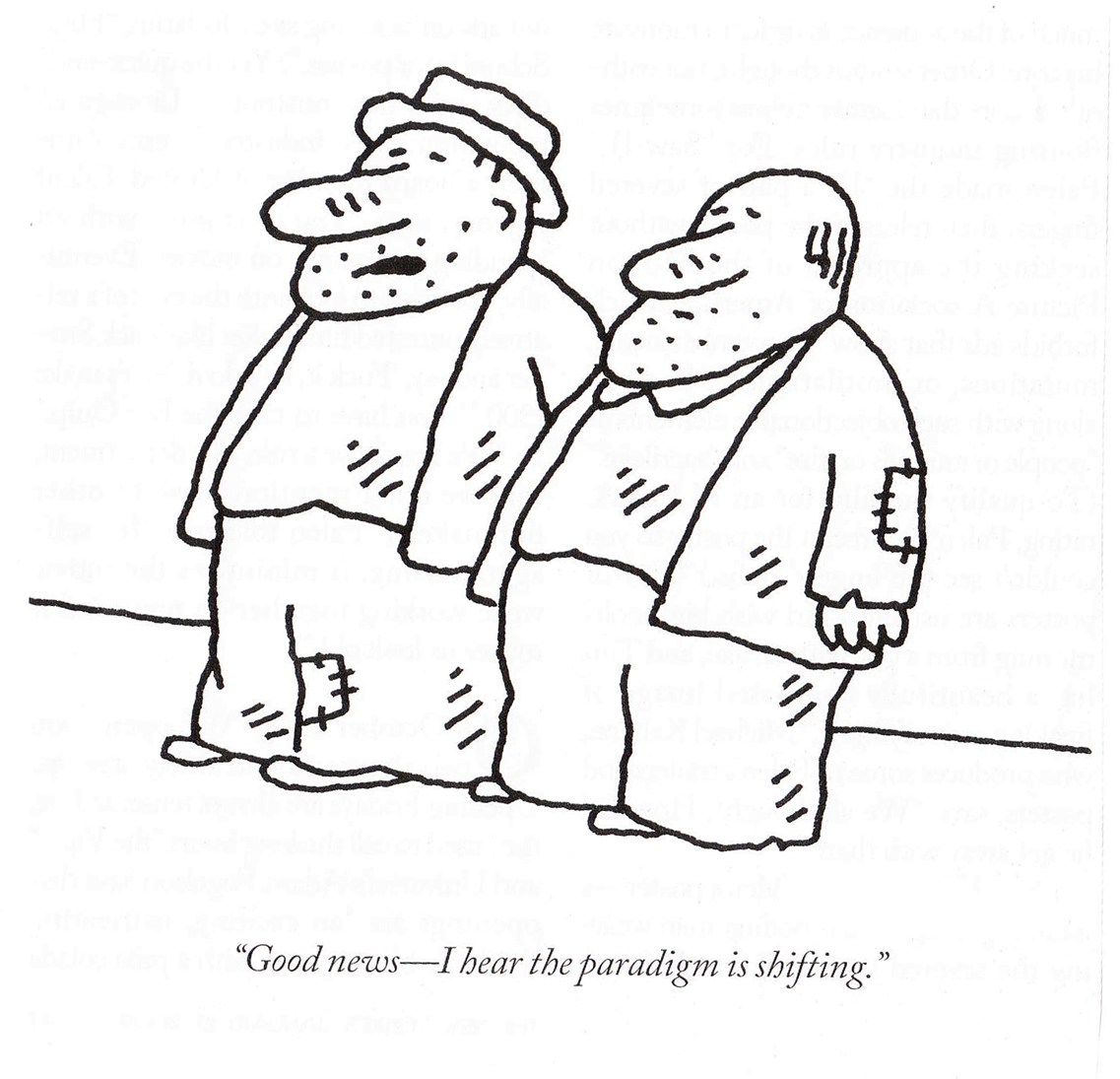
A pair of dimes shift (or paradigm shift if ya' had some fetchin' up) is the realization that, when casting lots, the dice are loaded!
Now mind you, whatever gods may be have NOTHING to do with loading the dice. It's the golden rule: he who has the gold, makes the rules.
In "rags to riches" mythology, by working hard one can achieve success. In other words, even if you are born on Sleazy Street (down the way from the Baptist Church) or near the open sewer behind Heavenly Splender Trailer Park, you can - with hard work alone - make it up to Easy Street.
People talk about rags-to-riches folks like Stanford Graduates or the son of a Seattle Banker. Well, good luck! (See? Casting lots.)
Now DO NOT get me wrong. I am the son of a mom & pop corner grocery store and I made it all the way up to Queezy Street - where those who should forever remain walking learn to drive.
And while I am not quite walking distance from easy street, we can drive up there a couple of times a year and pretend - for the weekend - that we have enough money to buy a dinner in that neighborhood.
How long must I dream?
And, American HICs on parade (BBC).
(This was the "other" Elvis.)
Wednesday, September 4, 2013
Of course! (Baka, Aho, Shinde kudasai)
In "cult speak," the world without mankind (Homo sapiens sapiens) in unbelievable. I use a form of belief - unbelievable - because a form of think - unthinkable - does not apply to religious (e.g. believing) cults.
We have destroyed the environment in which we can live. But, thank whatever gods may be, we have done it before - on the scale of a minicosm. THAT was Easter Island.
"In the prevailing account of the island's past, the native inhabitants once had a large and thriving society, but they doomed themselves by degrading their environment. A small group of Polynesian settlers arrived around 800 to 900 A.D., and the island's population grew slowly at first. Around 1200 A.D., their growing numbers (overpopulation) and an obsession with building moai led to increased pressure on the environment. By the end of the 17th century, the Rapanui had deforested the island, triggering war, bringing famine, leading to a vast starvation, and completing the cycle with complete cultural collapse." Call it ecocide.
Or was it the rats?
At any rate, religion is a crime against the mind.
The world WILL survive very well, thank you. It will do so without the human population it once held.
Conspiracy? No, just fate.
Secret Conspiracy? No, corporate profits from corporate prophets.
Bill Gates, on Math.
Tuesday, August 27, 2013
It is obvious
When I learned that the most profitable year in the history of 'Duesenberg Automobile & Motors Company, Inc' was in 1931 I thought:
"THAT was during the Great Depression following the crash of 1929."
Well, economic 'down turns' only effect the very little people (to paraphrase Leona Helmsley).
John Kenneth Galbraith wrote The Great Crash 1929, an economic history focused in part on the men of the market who brought on the crash, in graceful prose. In his last chapter, he tells us of five major weaknesses in the real economy that made it possible for the disaster to destroy a generation. At the top of his list is the badly unequal distribution of wealth.
He points out that the top 5% of the population earned about one third of all personal income in 1929*. Those figures comport well with the figures from Emanuel Saez and Thomas Piketty, whose IRS data indicates that the top 5% earned about 37% of gross income in 1929. P. 194 (references are to the Penguin Books 1992 ed.). For a discussion of the 2006 figures, see this article.
Productivity increased steadily from 1920 to 1929, but wages and prices were stagnant. P. 192 Costs fell, and profits increased, but how were the wealthy to dispose of the money? The choices were consumption of luxuries (e.g. a Duesenberg) or capital investment. There is only so much that the rich can consume.
If anything happened to reduce the flow of money to capital expenditures, consumer spending could not increase to take its place, and the economy was headed down. There is insufficient evidence, according to Galbraith, to be certain that this was the central cause, but he thinks the explanation is consistent with the observed facts available to him in 1954.
He identifies four other factors:
1. Bad corporate structures. Although the business press praised the businessmen of that day, the fact (P. 195) was that
American enterprise in the twenties had opened its hospitable arms to an exceptional number of swindlers, impostors, and frauds. This, in the long history of such activities, was a kind of flood tide of corporate larceny.
2. Bad banking structure. Galbraith doesn’t think bankers were any worse or better in the 20s than the 50s, but the structure of banks made runs on banks easier and more likely.
3. The balance of trade. The US was a creditor to most of the world. As the decade wore on, that status increased every year. High US tariffs made it difficult for other nations to balance their imports from the US with exports to the US, so accounts were settled in transfers of gold, or in shaky loans, like the loans made by National City Bank (predecessor, somehow, of CitiGroup) to Peru. P. 198-9. As this became more difficult, other countries had to reduce imports from the US, which caused strains in the economy, particularly agriculture.
4. Incompetent economic advice. From p. 200:
The economic advisors of the day had both the unanimity and authority to force the leaders of both political parties to disavow all the available steps to check deflation and depression.
Two and three seem unlikely culprits this time. It looks to me like a good case can be made for one, with all the money lost by the great geniuses of Wall Street and their counterparts in the banking and other businesses. What kind of country did our corporate masters think would be left when they exported all the decent jobs to other nations? Actually, it doesn’t affect them at the top. They just whine that they are being put upon by the great unwashed, and have to pretend they aren’t really all that different from you and me. When Newsweek notices it, it must be obvious.
As to four, judging competence isn’t easy. What do you think about the economic crowd? If you liked them pulling the strings for Bush, you’ll love them in their shape-shifted form manipulating Obama, including their supporters in the money party (e.g. the top 0.1%), the Blue Dogs and the rump of the Republican party. John Kenneth Galbraith would recognize these people too.
after an article published HERE
In today's 'world economy,' the top 5% of the population earn about 93% of all personal income! 95% of the population grovels over 5% of the wealth - the trickle down crumbs. To be fair, within the U.S.A., 5% earn 47% of all personal income! And that excludes many of the entitlement crowd* who live on investments alone (and your money specifically).
There are solid economic arguments for the bad consequences of unequal distribution of the wealth (which the USA has been consistently moving toward since Reagan).
*the entitlement crowd* consists of the ultra rich who find ways - like the story of home ownership in America - to make the poorer classes subsidize their vast wealth.
Subscribe to:
Posts (Atom)